About the Project
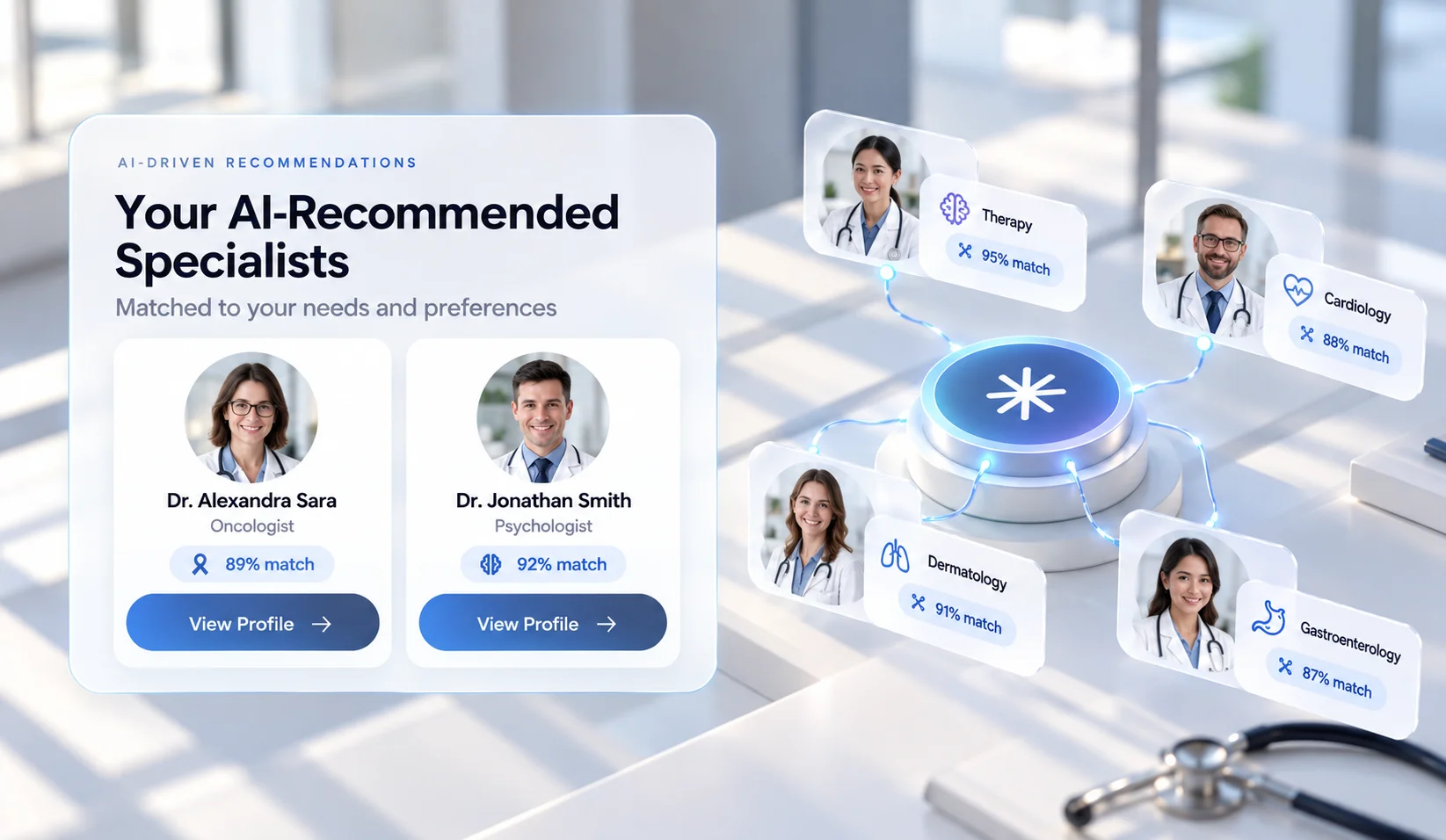
TechCare.Inc developed an AI-powered doctor recommendation system that intelligently matches patients with healthcare providers based on 50+ criteria. By implementing vector embedding technology with Weaviate and OpenAI, we created a fast, reliable, and semantically aware matching system that understands the nuanced relationship between patient needs and doctor specializations.
Performance Highlights
<2s
Matching Response
82%
Relevance Accuracy
200+
Doctors Indexed
1,000+
Active Users
The Challenges
Doctor Pool Management: Maintain a comprehensive database with dynamic updates and efficient querying across large datasets.
Multi-Dimensional Criteria (50+ attributes):

User-Centric Onboarding: Intelligent questionnaire capturing patient preferences while balancing comprehensiveness with user experience and privacy.
Matching Performance: Sub-second response times, high accuracy, explainable recommendations, scalable to thousands of concurrent users.
AI-Driven Intelligence: Semantic understanding beyond keyword matching, context-aware recommendations, learning from interactions, handling ambiguous inputs.
Why Vector Embeddings?
After evaluating rule-based algorithmic matching versus vector embeddings, we chose the vector approach for its superior semantic understanding. The system recognizes that "pediatrician specializing in autism" and "child development specialist with ASD experience" represent highly similar concepts, even without exact keyword matches.
Key Advantages:
Solution Architecture

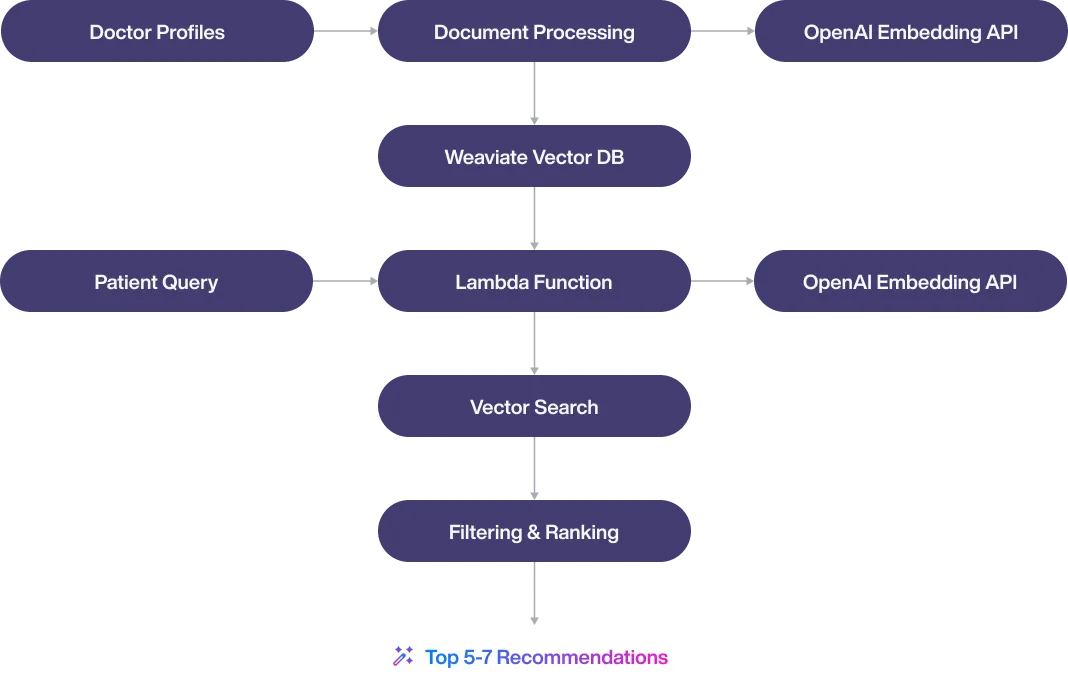
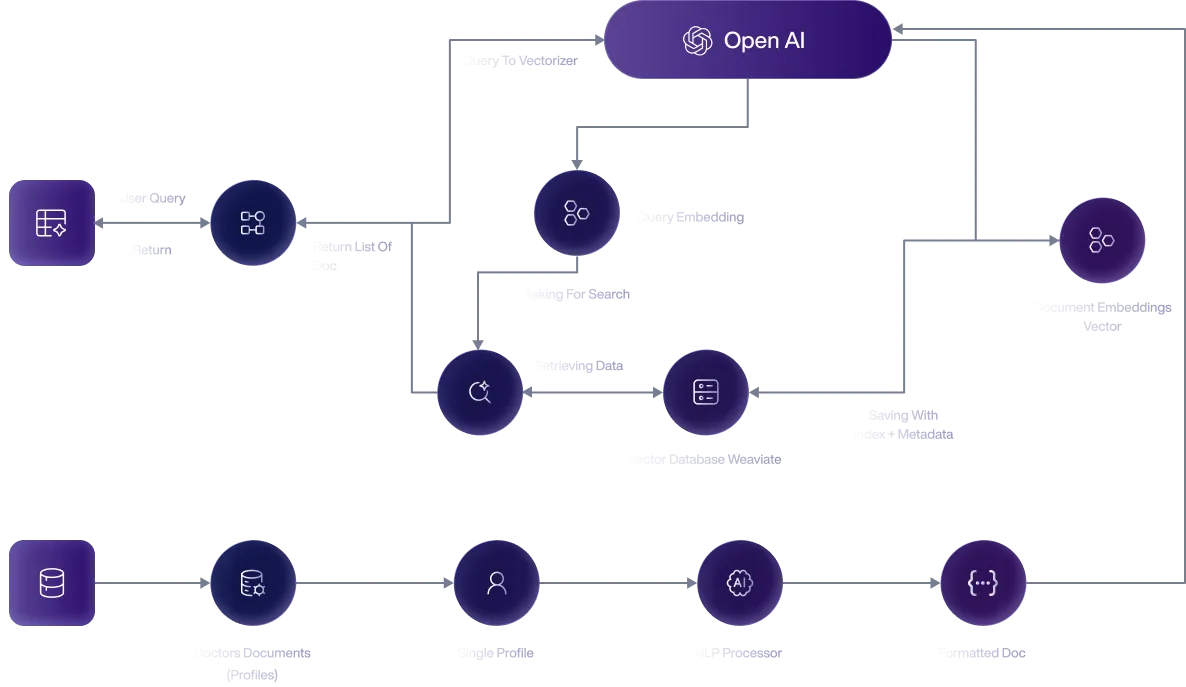
Phase 1: Doctor Profile Vectorization Pipeline
Profile Document Preparation
Batch Processing Infrastructure (AWS ECS)

Phase 2: User Query Processing Pipeline
User-Facing Lambda Service
Serverless architecture handling patient queries:
- Example: {age: 35, concern: "back pain", language: "Spanish", location: "Miami"}
- Generated: "Looking for a doctor who treats back pain in adults, speaks Spanish fluently, and practices in Miami area. Prefer orthopedic or physical medicine expertise."
- Embed using OpenAI API (same model as profiles)
System Architecture
Implementation Details
| Technology Stack | Performance Optimization |
|---|---|
| Backend: AWS ECS, AWS Lambda, API Gateway, Python 3.11+, FastAPI | Batch processing with OpenAI's batch API (50% cost reduction) |
| Vector: Weaviate with HNSW algorithm, hybrid search (vector + keyword) | Pre-computed embeddings with caching |
| AI: OpenAI Embedding API (text-embedding-3-large), OpenAI Python SDK | Approximate nearest neighbor search (ANN) |
| Data: NumPy, Pandas | Progressive filtering and result caching |
| Monitoring: CloudWatch, custom metrics, A/B testing framework | Horizontal Lambda scaling, Weaviate clustering |
Current Status & Results
System Performance (Beta)
Matching Accuracy
Key Learnings
Benefits Achieved
For Patients: Time reduction from hours to seconds, discovery of relevant specialists, personalized recommendations, improved confidence
For Healthcare Providers: Better matching accuracy, improved utilization, reduced no-shows, demand analytics
For TechCare: 60% reduction in support queries, scalable growth, demand insights, foundation for AI features
Challenges & Solutions
API Latency & Cost
Pre-compute embeddings, use batch API (50% savings), implement CDN distribution
Cold Start
Hybrid scoring weights structured criteria higher for new doctors until interaction data exists
Criteria Imbalance
Two-stage filtering—hard constraints first, semantic similarity within qualified subset
Compliance
HIPAA-compliant architecture, disclaimers, human oversight for flagged cases
Lessons Learned
Hybrid Approach: Combines AI innovation with reliability
Explainability: Critical for healthcare context and user trust
Data Quality: Well-structured profiles produce better embeddings
API Optimization: Batch processing and caching control costs
Continuous Monitoring: Track both technical and business metrics
Scale Planning: Design for 10x growth from day one
Conclusion
TechCare's AI-driven doctor recommendation system represents a significant advancement in healthcare matching technology. By leveraging vector embeddings and semantic search, we've created a system that understands nuanced relationships between patient needs and provider capabilities far beyond traditional keyword matching.